
MGMT Promoter Methylation is associated with epigenetic silencing of DNA repair mechanisms, and provides supportive information for glioblastoma and glioma evaluation.
MGMT promoter methylation is a real-time quantitative PCR (RT-qPCR) assay, designed to detect and quantify methylation in the promoter region of the O6-methylguanine-DNA methyltransferase (MGMT) gene.
Our test uses methylation-specific amplification and an internal reference control to generate a normalized result based on ΔCt analysis, and determines methylation status by evaluating CpG sites within the MGMT promoter region.
MGMT promoter methylation status is correlated with response to alkylating chemotherapy (e.g., temozolomide), and associated with epigenetic silencing of DNA repair mechanisms.
Why Use the MGMT Promoter Methylation Test?
Enables rapid, reliable assessment from FFPE tumor tissue, with no bisulfite conversion required.
Provides clinically relevant molecular insight for glioblastoma and glioma evaluation
Complements histopathology and other molecular testing to support clinical decision-making
Built-in internal control ensures assay quality and data integrity
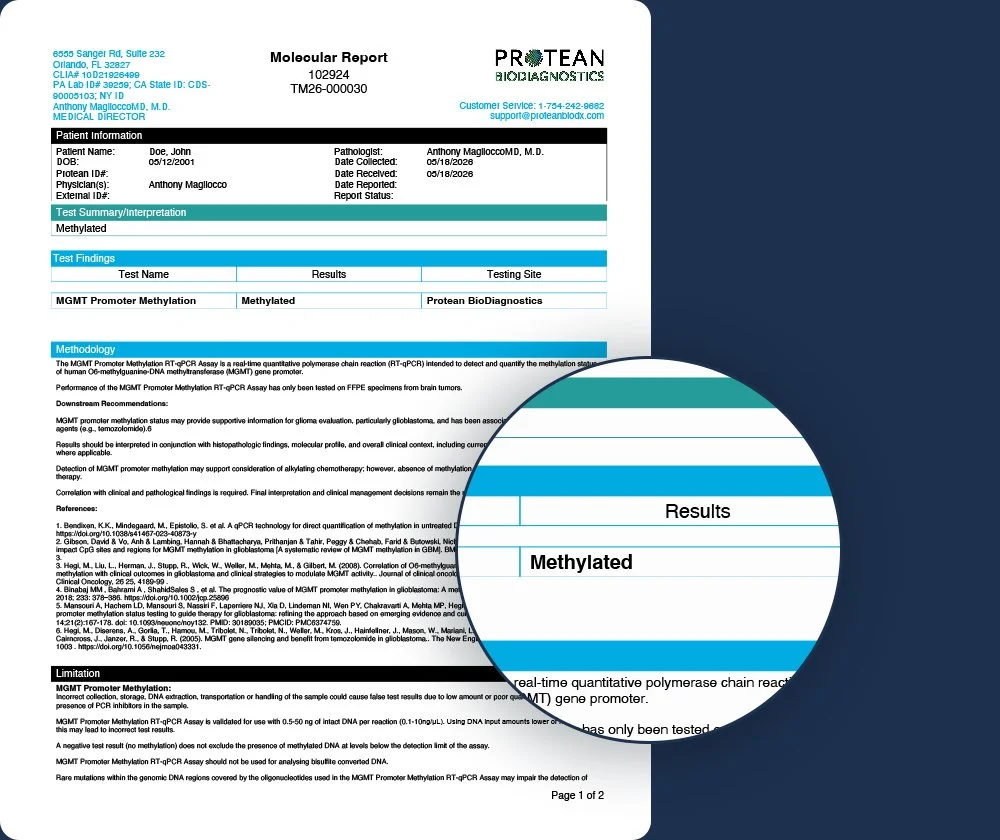
Protean’s MGMT Promoter Methylation report provides the information you need in a clear and easy to understand format.
Methylated: Detection of MGMT promoter methylation within targeted regions
Non-Methylated: No detectable methylation within assay limits

Who’s Eligible for This Test?
Patients ≥18 years with suspected or confirmed glioma, including glioblastoma
Patients undergoing molecular profiling for treatment planning
Cases with available FFPE tumor tissue
Ordering Process:
Complete the test requisition form
Send the completed test requisition form via fax or Protean’s secure electronic portal
Ship tissue or slides with pathology report to Protean’s laboratory
Receive results within 2-3 business days
Sample Requirements:
Tissue block, or minimum of 10 slides.
Overnight shipping required for tissue blocks.
Regular shipping for slides.
Details for slides: 5 micron thick sections, unstained & unbaked, 25 mm² (if less than this size, please provide additional slides), H&E optional
Order MGMT Promoter Methylation
Fill out your name and email address below and someone from Protean’s support team will be in touch shortly.
References
Bendixen, K.K., Mindegaard, M., Epistolio, S. et al. A qPCR technology for direct quantification of methylation in untreated DNA. Nat Commun 14, 5153 (2023). https://doi.org/10.1038/s41467-023-40873-y
Gibson, David & Vo, Anh & Lambing, Hannah & Bhattacharya, Prithanjan & Tahir, Peggy & Chehab, Farid & Butowski, Nicholas. (2024). A systematic review of high impact CpG sites and regions for MGMT methylation in glioblastoma [A systematic review of MGMT methylation in GBM]. BMC Neurology. 24. 10.1186/s12883-024-03605-3.
Hegi, M., Liu, L., Herman, J., Stupp, R., Wick, W., Weller, M., Mehta, M., & Gilbert, M. (2008). Correlation of O6-methylguanine methyltransferase (MGMT) promoter methylation with clinical outcomes in glioblastoma and clinical strategies to modulate MGMT activity. Journal of clinical oncology: official journal of the American Society of Clinical Oncology, 26 25, 4189-99.
Binabaj MM, Bahrami A, ShahidSales S, et al. The prognostic value of MGMT promoter methylation in glioblastoma: A meta-analysis of clinical trials. J Cell Physiol. 2018; 233: 378–386. https://doi.org/10.1002/jcp.25896
Mansouri A, Hachem LD, Mansouri S, Nassiri F, Laperriere NJ, Xia D, Lindeman NI, Wen PY, Chakravarti A, Mehta MP, Hegi ME, Stupp R, Aldape KD, Zadeh G. MGMT promoter methylation status testing to guide therapy for glioblastoma: refining the approach based on emerging evidence and current challenges. Neuro Oncol. 2019 Feb 14;21(2):167-178. doi: 10.1093/neuonc/noy132. PMID: 30189035; PMCID: PMC6374759
Hegi, M., Diserens, A., Gorlia, T., Hamou, M., Tribolet, N., Tribolet, N., Weller, M., Kros, J., Hainfellner, J., Mason, W., Mariani, L., Bromberg, J., Hau, P., Mirimanoff, R., Cairncross, J., Janzer, R., & Stupp, R. (2005). MGMT gene silencing and benefits from temozolomide in glioblastoma. The New England Journal of Medicine, 352 10, 997-1003. https://doi.org/10.1056/nejmoa043331